ProductsDesktop toolsTASTECADDrawing reviewTASTEFILESFile managementTASTEFTPFile transferTASTESSHRemote workspaceTASTEZIPCompression and extractionTASTEWINMFile managementDeveloper toolsTASTECODERust integrated development environmentTASTESTUDIOIntegrated development and test environmentTASTEETLData integration (ETL)ServersTASTEREMOTERemote desktop serverTASTEGEOGeospatial serverTASTEMAILMail workspaceInvestingTASTESTOCKStock auto-trading desktop appGet startedDownloadsDocumentationBuyAll products
Marketplace
News
TechNewsToday's dev newsDeveloper docsProgramming languagesRustTypeScriptJavaScriptPythonGoC#JavaCC++KotlinDartWeb front-end frameworksNext.jsReactVue.js · NuxtSvelteKitAngularServer frameworksSpring BootDjangoFastAPIASP.NET CoreNestJS · ExpressApp & desktop frameworksTauriFlutterReact NativeElectronAlgorithmsAlgorithm basicsCore algorithmsAdvanced algorithmsPractical algorithms
CommunityProjectsDevelopment logsPromptsAI tool issuesShowcaseCommunity guide
Work with usTech transferWebsite buildDesktop app buildRelease and payment pipelineSales partnerContact
ServicesRemote desktopCustom installer packages
TASTEDEV
Products

Desktop tools

TASTECADComplex drawings, opened with easeTASTEFILESJust the files you need, as fast as possibleTASTEFTPThe tidiest path for your filesTASTESSHA stronger link between you and your serversTASTEZIPPack faster, unpack saferTASTEWINMA keyboard-first file manager with two panes

Developer tools

TASTECODEEdit, build, debug and test Rust apps in one windowTASTESTUDIOFrom editing to remote tests and approved AI fixesTASTEETLMove data while you watch the values

Servers

TASTEREMOTEA remote desktop you run on your own serverTASTEGEORebuilding a GeoServer-compatible geospatial server in RustTASTEMAILTake back control of your email

Investing

TASTESTOCKStock auto-trading that follows the rules you set: when, and what

Get started

DownloadsLatest builds of every productDocsHow to use each productBuySubscriptions and perpetual licencesAll productsEvery product at a glance
All products
MarketplaceNews
Tech

News

Today's dev newsOfficial announcements on languages, frameworks, GitHub and AIDeveloper docsGuides to languages, frameworks and algorithms

Programming languages

RustTypeScriptJavaScriptPythonGoC#JavaCC++KotlinDart

Frameworks

Web front-end frameworksNext.jsReactVue.js · NuxtSvelteKitAngular
Server frameworksSpring BootDjangoFastAPIASP.NET CoreNestJS · Express
App & desktop frameworksTauriFlutterReact NativeElectron

Algorithms

Algorithm basicsComplexity analysis · Sorting · Searching · Basic data structures · Trees and heapsCore algorithmsGraph traversal · Shortest paths & minimum spanning trees · Dynamic programming · Greedy algorithms · Divide and conquer · BacktrackingAdvanced algorithmsString algorithms · Math and number theory · Bit manipulation · Segment trees · Union-findPractical algorithmsCoding interview strategy · LRU cache · Rate limiting · Consistent hashing
All development docs
Community
ProjectsDiscover builders and their workDevelopment logsDecisions and lessons learnedPromptsReusable instructionsAI tool issuesProblems and workarounds for Claude, Codex, GeminiShowcaseFinished resultsCommunity guideHow we build in the open
Work with us
Tech transferNative apps in Rust and eguiWebsite build10 languages, accounts, docs and downloadsDesktop app buildRust and egui, no WebViewRelease and payment pipelineSigning, MSI, deb, rpm, AppImage, hashesSales partnerRecommend us and earn 30%ContactBuilds, partnerships and investment
Services
Remote desktopReach your computer from a browserCustom installer packagesOnly the features you need, settings preloaded
Buy
EN
한국어EnglishDeutschEspañolFrançaisItalianoPortuguês (Brasil)日本語简体中文繁體中文
Log in
Log in
TASTEDEV

From small tools to better development.

support@tastedev.netSupport TASTEDEV
ProductsProduct lineupBuyDocsDownloadsMarketplaceSupport
CommunityProjectsDevelopment logsPromptsAI tool issuesShowcase
PoliciesAbout usPrivacy policyTerms of serviceSubscription termsRefund policyCommunity guidelines
AccountLog inSign up
Visitors
Today
Yesterday
Total views
Company
GXSOFT
Representative
CHOI YOUNG GU
Business registration number
853-44-00368
Address
9F V24, 351 Gyeongin-ro, Michuhol-gu, Incheon, Republic of Korea
Phone
+82-10-4404-1523
Email
whitecalvin@tastedev.net
Privacy officer
CHOI YOUNG GU

© 2026 TASTEDEVProduct information is based on verified development sources.Released · improving

TASTESSHguide
Installation and first launchInterface and menusHosts, groups and vaultsAuthentication, private keys and host keysTerminals and connection tabsWorkspaces and tab groupsServer monitoringSFTP browsing and file transfersPort forwarding and snippetsLocal terminals and serial connectionsLogs and synchronizationSettings, appearance and securityUpdates and licencesShortcuts and troubleshootingCommand line and advanced managementSupported scope and precautions

TASTESSH guide

Hosts, groups and vaults

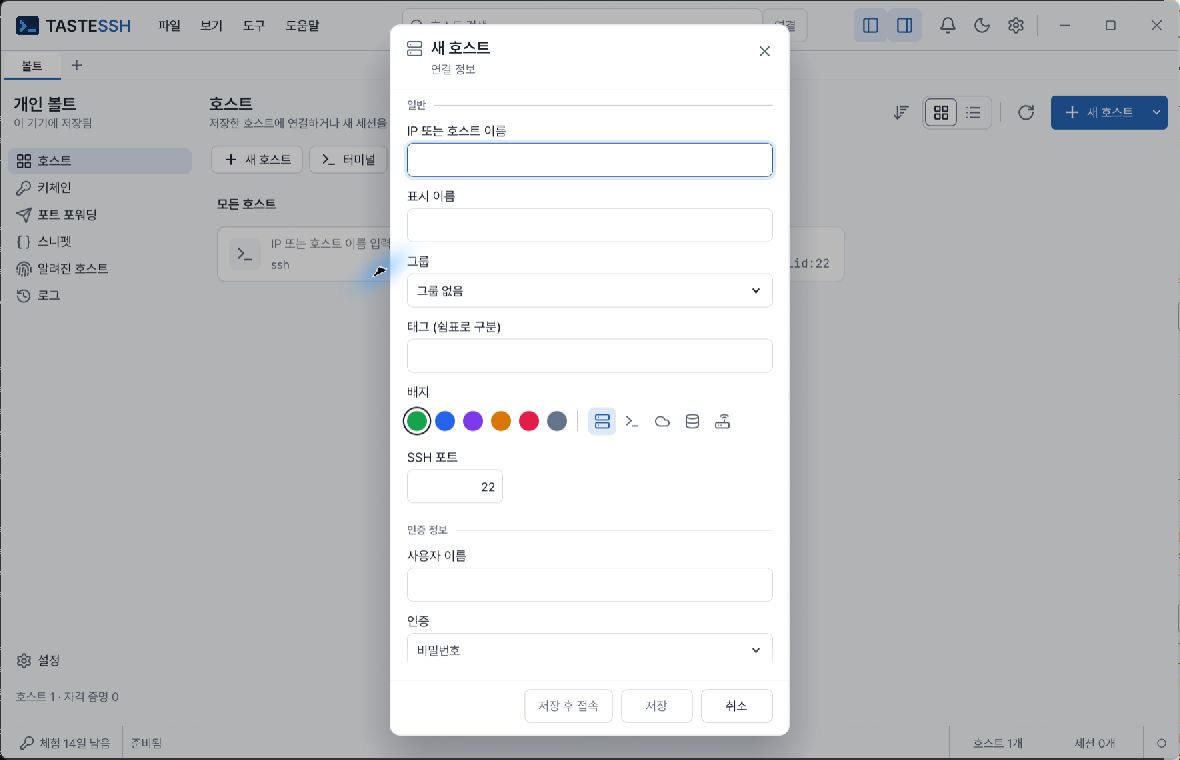
Address, group, port and authentication fields for a new host

Quick connection and detailed editing

Prepare server access permission and the correct address first. Host search/connect at the top, or inline input on the Hosts screen, allows searching saved hosts and entering a connection target. Do not assume unsaved input has become a permanent host; check the host list.

  1. Open New host and specify name, address, port, username and authentication method.
  2. Use an existing host's Edit button to modify the same fields. Follow Authentication for private keys.
  3. Add intermediate servers to the host chain in order; when using a proxy, check type, address, port and account.
  4. After saving, check for error notifications and connect from the saved host.

Distinguish servers using available list/edit fields such as tags, groups, icons, colors, favorites and host-specific terminal appearance. When dragging a host into a group or creating one inside a group, check the destination group. Use the CLI for advanced management not exposed in the interface, such as group default authentication, startup actions, default SFTP paths or proxy inheritance.

Vault management scope

A vault defines the scope of saved data such as hosts, groups and authentication entries. Distinguish the desktop's default navigation screen from CLI commands managing multiple vaults. Do not assume all vault creation/switching screens exist on the desktop. Check distributed CLI help for vaults, vault-add, vault-edit and vault-remove to list, create, rename or delete multiple vaults. Preserve export/synchronization data and connection settings before deleting.

The expected result is a saved host showing the intended group and address. If saving fails, inspect the error, path permissions and existing changes instead of repeatedly creating the same host.

First SSH connection

Prepare the server address, SSH port, username, password or SSH key, and server SSH host-key fingerprint. Use values supplied by the server administrator.

  1. Choose Hosts → New host.
  2. Enter a recognizable name, server address, port and username. The usual SSH port is 22, but use the configured value if different.
  3. Choose an authentication method. For passwords or registered keys, enter or select the relevant credentials. Prepare an SSH agent in the operating system beforehand if used.
  4. Select the saved host and connect.
  5. If an unfamiliar host key is blocked or requires confirmation, verify its fingerprint with the administrator through a separate channel. Trust the new key and reconnect only if it matches.
  6. Once the terminal opens, check that server name and user account are the intended destination. On a Linux server, for example, use hostname and whoami.

The host key verifies server identity; the user's SSH key is for login. They serve different purposes: do not confuse them.

Managing hosts and groups

  • Search saved servers in Hosts and switch between card and list views.
  • Use New group to group servers by work or environment, such as development, testing and production.
  • After changing addresses or authentication, inspect the save result and recheck the next connection target.
  • Deleting a host removes connection settings. It does not delete the server or files on it.

Clearly distinguish production and development servers by name. Check the selected host before deletion or modification. Changing Vault can change the displayed data scope, so check the currently selected Vault too.

PreviousInterface and menusNextAuthentication, private keys and host keys

On this page

  1. Quick connection and detailed editing
  2. Vault management scope
  3. First SSH connection
  4. Managing hosts and groups
Suggest an edit